 Add to Chrome
 Add to Firefox
 Add to Edge
CAGE-SGG: Counterfactual Active Graph Evidence for Open-Vocabulary Scene Graph Generation
Apr 28, 2026
Open-vocabulary scene graph generation (SGG) aims to describe visual scenes with flexible and fine-grained relation phrases beyond a fixed predicate vocabulary. While recent vision-language models greatly expand the semantic coverage of SGG, they also introduce a critical reliability issue: predicted relations may be driven by language priors or object co-occurrence rather than grounded visual evidence. In this paper, we propose an evidence-rounded open-vocabulary SGG framework based on counterfactual relation verification. Instead of directly accepting plausible relation proposals, our method verifies whether each candidate relation is supported by relation-pecific visual, geometric, and contextual evidence. Specifically, we first generate open-vocabulary relation candidates with a vision-language proposer, then decompose predicate phrases into soft evidence bases such as support, contact, containment, depth, motion, and state. A relation-conditioned evidence encoder extracts predicate-relevant cues, while a counterfactual verifier tests whether the relation score decreases when necessary vidence is removed and remains stable under irrelevant perturbations. We further introduce contradiction-aware predicate learning and graph-level preference optimization to improve fine-grained discrimination and global graph consistency. Experiments on conventional, open-vocabulary, and panoptic SGG benchmarks show that our method consistently improves standard recall-based metrics, unseen predicate generalization, and counterfactual grounding quality. These results demonstrate that moving from relation generation to relation verification leads to more reliable, interpretable, and evidence-grounded scene graphs.

DLink: Distilling Layer-wise and Dominant Knowledge from EEG Foundation Models
Apr 16, 2026EEG foundation models (FMs) achieve strong cross-subject and cross-task generalization but impose substantial computational and memory costs that hinder deployment on embedded BCI systems. Knowledge distillation is a natural solution; however, conventional methods fail for EEG FMs because task-relevant semantics are often distributed across intermediate layers, and aggressive dimensionality reduction can distort oscillatory structure via representational collapse and aliasing. To address these challenges, we propose DLink (Distilling Layer-wise and Dominant Knowledge), a unified framework for transferring knowledge from large EEG FMs to compact students with three key innovations: (1) a dynamic Router that adaptively aggregates teacher layers to capture dominant intermediate representations; (2) an EEG MiC student with a Mimic-then-Compress pipeline, which inherits high-dimensional teacher features and then applies structured spatio-temporal compression to avoid a heavy classification head; and (3) spectral distillation that aligns teacher-student representations in the frequency domain to regularize compression and mitigate aliasing and temporal jitter. Experiments on four EEG benchmarks show that DLink enables compact students to outperform lightweight baselines while approaching fully fine-tuned FM performance at substantially lower model size and inference cost.
TDATR: Improving End-to-End Table Recognition via Table Detail-Aware Learning and Cell-Level Visual Alignment
Mar 24, 2026Tables are pervasive in diverse documents, making table recognition (TR) a fundamental task in document analysis. Existing modular TR pipelines separately model table structure and content, leading to suboptimal integration and complex workflows. End-to-end approaches rely heavily on large-scale TR data and struggle in data-constrained scenarios. To address these issues, we propose TDATR (Table Detail-Aware Table Recognition) improves end-to-end TR through table detail-aware learning and cell-level visual alignment. TDATR adopts a ``perceive-then-fuse'' strategy. The model first performs table detail-aware learning to jointly perceive table structure and content through multiple structure understanding and content recognition tasks designed under a language modeling paradigm. These tasks can naturally leverage document data from diverse scenarios to enhance model robustness. The model then integrates implicit table details to generate structured HTML outputs, enabling more efficient TR modeling when trained with limited data. Furthermore, we design a structure-guided cell localization module integrated into the end-to-end TR framework, which efficiently locates cell and strengthens vision-language alignment. It enhances the interpretability and accuracy of TR. We achieve state-of-the-art or highly competitive performance on seven benchmarks without dataset-specific fine-tuning.
Structured Prototype-Guided Adaptation for EEG Foundation Models
Feb 19, 2026Electroencephalography (EEG) foundation models (EFMs) have achieved strong performance under full fine-tuning but exhibit poor generalization when subject-level supervision is limited, a common constraint in real-world clinical settings. We show that this failure stems not merely from limited supervision, but from a structural mismatch between noisy, limited supervision and the highly plastic parameter space of EFMs. To address this challenge, we propose SCOPE, a Structured COnfidence-aware Prototype-guided adaptation framework for EFM fine-tuning. SCOPE follows a two-stage pipeline. In the first stage, we construct reliable external supervision by learning geometry-regularized task priors, constructing balanced class-level prototypes over the resulting embeddings, and producing confidence-aware pseudo-labels from their agreement to filter unreliable signals on unlabeled data. In the second stage, we introduce ProAdapter, which adapts frozen EEG foundation models via a lightweight adapter conditioned on the structured prototypes. Experiments across three EEG tasks and five foundation model backbones demonstrate that SCOPE consistently achieves strong performance and efficiency under label-limited cross-subject settings.
Kimi K2.5: Visual Agentic Intelligence
Feb 02, 2026We introduce Kimi K2.5, an open-source multimodal agentic model designed to advance general agentic intelligence. K2.5 emphasizes the joint optimization of text and vision so that two modalities enhance each other. This includes a series of techniques such as joint text-vision pre-training, zero-vision SFT, and joint text-vision reinforcement learning. Building on this multimodal foundation, K2.5 introduces Agent Swarm, a self-directed parallel agent orchestration framework that dynamically decomposes complex tasks into heterogeneous sub-problems and executes them concurrently. Extensive evaluations show that Kimi K2.5 achieves state-of-the-art results across various domains including coding, vision, reasoning, and agentic tasks. Agent Swarm also reduces latency by up to $4.5\times$ over single-agent baselines. We release the post-trained Kimi K2.5 model checkpoint to facilitate future research and real-world applications of agentic intelligence.
LoRAP: Low-Rank Aggregation Prompting for Quantized Graph Neural Networks Training
Jan 21, 2026Graph Neural Networks (GNNs) are neural networks that aim to process graph data, capturing the relationships and interactions between nodes using the message-passing mechanism. GNN quantization has emerged as a promising approach for reducing model size and accelerating inference in resource-constrained environments. Compared to quantization in LLMs, quantizing graph features is more emphasized in GNNs. Inspired by the above, we propose to leverage prompt learning, which manipulates the input data, to improve the performance of quantization-aware training (QAT) for GNNs. To mitigate the issue that prompting the node features alone can only make part of the quantized aggregation result optimal, we introduce Low-Rank Aggregation Prompting (LoRAP), which injects lightweight, input-dependent prompts into each aggregated feature to optimize the results of quantized aggregations. Extensive evaluations on 4 leading QAT frameworks over 9 graph datasets demonstrate that LoRAP consistently enhances the performance of low-bit quantized GNNs while introducing a minimal computational overhead.
Deep Learning for Semantic Segmentation of 3D Ultrasound Data
Jan 19, 2026Developing cost-efficient and reliable perception systems remains a central challenge for automated vehicles. LiDAR and camera-based systems dominate, yet they present trade-offs in cost, robustness and performance under adverse conditions. This work introduces a novel framework for learning-based 3D semantic segmentation using Calyo Pulse, a modular, solid-state 3D ultrasound sensor system for use in harsh and cluttered environments. A 3D U-Net architecture is introduced and trained on the spatial ultrasound data for volumetric segmentation. Results demonstrate robust segmentation performance from Calyo Pulse sensors, with potential for further improvement through larger datasets, refined ground truth, and weighted loss functions. Importantly, this study highlights 3D ultrasound sensing as a promising complementary modality for reliable autonomy.
AppellateGen: A Benchmark for Appellate Legal Judgment Generation
Jan 08, 2026Legal judgment generation is a critical task in legal intelligence. However, existing research in legal judgment generation has predominantly focused on first-instance trials, relying on static fact-to-verdict mappings while neglecting the dialectical nature of appellate (second-instance) review. To address this, we introduce AppellateGen, a benchmark for second-instance legal judgment generation comprising 7,351 case pairs. The task requires models to draft legally binding judgments by reasoning over the initial verdict and evidentiary updates, thereby modeling the causal dependency between trial stages. We further propose a judicial Standard Operating Procedure (SOP)-based Legal Multi-Agent System (SLMAS) to simulate judicial workflows, which decomposes the generation process into discrete stages of issue identification, retrieval, and drafting. Experimental results indicate that while SLMAS improves logical consistency, the complexity of appellate reasoning remains a substantial challenge for current LLMs. The dataset and code are publicly available at: https://anonymous.4open.science/r/AppellateGen-5763.
Chinese Morph Resolution in E-commerce Live Streaming Scenarios
Dec 29, 2025E-commerce live streaming in China, particularly on platforms like Douyin, has become a major sales channel, but hosts often use morphs to evade scrutiny and engage in false advertising. This study introduces the Live Auditory Morph Resolution (LiveAMR) task to detect such violations. Unlike previous morph research focused on text-based evasion in social media and underground industries, LiveAMR targets pronunciation-based evasion in health and medical live streams. We constructed the first LiveAMR dataset with 86,790 samples and developed a method to transform the task into a text-to-text generation problem. By leveraging large language models (LLMs) to generate additional training data, we improved performance and demonstrated that morph resolution significantly enhances live streaming regulation.
EEG-DLite: Dataset Distillation for Efficient Large EEG Model Training
Dec 13, 2025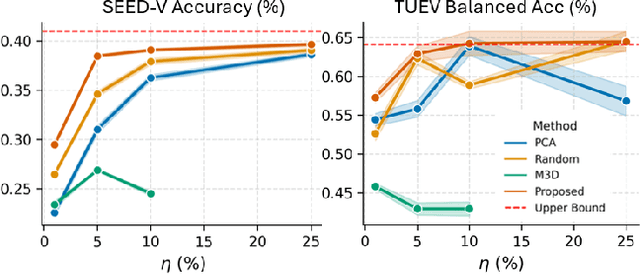
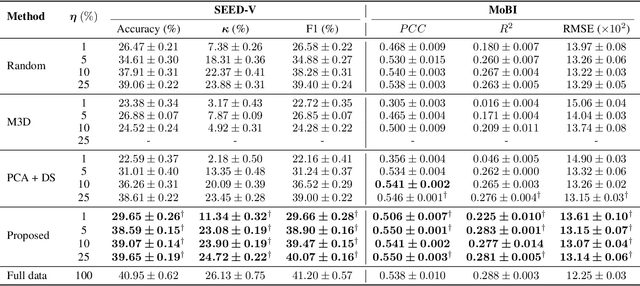
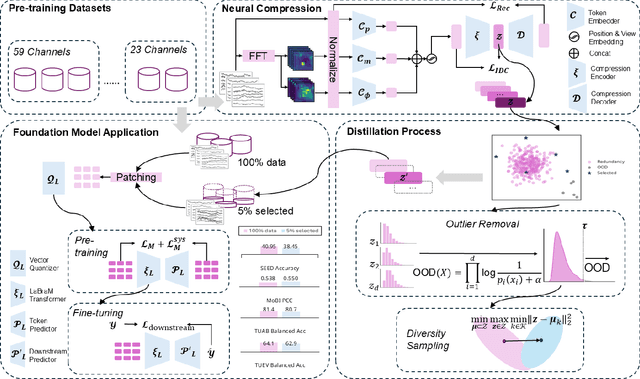
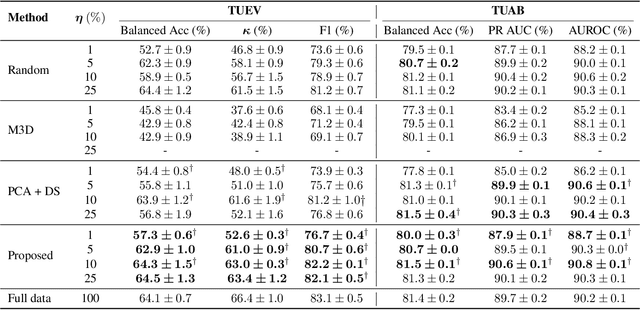
Large-scale EEG foundation models have shown strong generalization across a range of downstream tasks, but their training remains resource-intensive due to the volume and variable quality of EEG data. In this work, we introduce EEG-DLite, a data distillation framework that enables more efficient pre-training by selectively removing noisy and redundant samples from large EEG datasets. EEG-DLite begins by encoding EEG segments into compact latent representations using a self-supervised autoencoder, allowing sample selection to be performed efficiently and with reduced sensitivity to noise. Based on these representations, EEG-DLite filters out outliers and minimizes redundancy, resulting in a smaller yet informative subset that retains the diversity essential for effective foundation model training. Through extensive experiments, we demonstrate that training on only 5 percent of a 2,500-hour dataset curated with EEG-DLite yields performance comparable to, and in some cases better than, training on the full dataset across multiple downstream tasks. To our knowledge, this is the first systematic study of pre-training data distillation in the context of EEG foundation models. EEG-DLite provides a scalable and practical path toward more effective and efficient physiological foundation modeling. The code is available at https://github.com/t170815518/EEG-DLite.